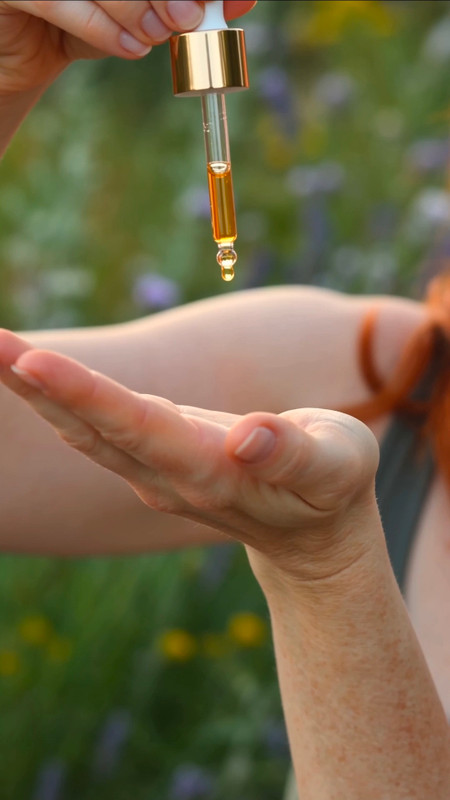
There is a moment, when you open a bottle of Wilder North serum for the first time, that something registers before thought does. The scent is not clean the way a conventional product is clean. It is alive the way a garden is alive — layered, complex, slightly different each time, carrying within it something that cannot be synthesized because it was never designed. It was grown.
This is not marketing language. It is biology. And it is the foundational principle behind everything we make.
✦What we mean by a living formula
Most skin care products are dead on arrival. Not by negligence — by design. Conventional formulas are engineered for shelf stability, batch-to-batch consistency, and a two-year expiration date. To achieve this, manufacturers use heat processing that destroys thermolabile plant compounds, solvent extractions that isolate single molecules and discard the rest, synthetic preservatives that prevent biological activity from occurring at all, and emulsifiers that force incompatible substances together using chemistry that has no relationship to how skin actually works.
The result is a product that performs predictably, ships reliably, and contains almost nothing alive.
Our formulas are built on a different premise entirely. We begin with whole plants — not extracts, not isolates, not standardized fractions — and we slow-infuse them in their entirety into cold-pressed carrier oils over an extended period of time. What happens during that maceration is not a simple transfer of one compound from one vessel to another. It is a complex, living conversation between plant and oil — a process in which the full spectrum of a plant's chemistry, including compounds we haven't yet named or studied, migrates into the oil and remains intact.
The result is a formula that behaves differently on skin than anything engineered from parts. It absorbs differently. It interacts with the skin's biology differently. And it smells entirely unlike anything assembled in a laboratory — because the scent, like the formula itself, is whole.
✦The science of plant vitality
Every plant is a chemical factory of extraordinary sophistication. In response to light, temperature, pest pressure, soil composition, water availability, and seasonal cues, a plant produces thousands of compounds — terpenoids, flavonoids, phenolic acids, alkaloids, carotenoids, volatile oils — that regulate its growth, protect it from threat, attract pollinators, communicate with neighboring plants, and repair its own tissue when damaged.
This chemistry is not static. It is dynamic and responsive. A rose harvested at dawn, when its essential oil content peaks, carries a different chemical profile than one harvested at midday. A hawthorn berry from a plant that survived a hard frost carries more protective polyphenols than one grown in a mild climate.[1] An elderflower picked at the height of its bloom retains medicinal qualities that simply cannot be preserved through conventional extraction.
Studies confirm that cold and temperature stress actively induces plants to synthesize bioactive phenolic compounds — including phenolic acids, anthocyanins, flavonoids, and flavonols — which serve as crucial protective molecules during stress responses and function as potent antioxidants.[1,2]
This is what herbalists have known for centuries and what biochemistry is now confirming: the aliveness of a plant at the moment of harvest, and the integrity with which it is processed afterward, determines the potency of the medicine it delivers.
We build our entire formulation process around this understanding. We source from farms that harvest at peak vitality. We process immediately. We never use heat. We never isolate single compounds when the whole plant is available to us. And we let the maceration proceed at its own pace — because slow extraction preserves what rapid processing destroys.
✦On high vibrational plants
In herbalist tradition and in the emerging field of plant biophysics, the concept of a plant's vibrational quality refers to something real, even if the language is not yet fully captured by conventional science.
Every living organism emits biophotons — low-level light emissions produced by biological processes within living cells. Plants are no exception. Emerging research into plant biophoton emission has found measurable differences between organically grown and conventionally grown plants, between freshly harvested and processed plant material, and between plants grown in healthy soil ecosystems and those grown in depleted or chemically treated environments.[3,4]
A 2025 study published in NCBI found that organic fruits consistently emitted slightly higher biophoton levels than conventional ones, suggesting subtle but measurable differences in their biochemical properties and biological vitality.[4] Pioneering biophoton researcher F. Popp first demonstrated in 1988 that ultra-weak photon emission could distinguish between conventionally grown and organic produce — work that established the scientific foundation for this field.[3]
The plants we source — certified organic, wildcrafted from natural landscapes, harvested from regenerative small farms — are not simply cleaner than conventionally grown alternatives. They are more biologically active. More coherent in their light emission. More complex in their chemistry. In the language of plant medicine, they carry a higher vibrational quality — meaning they carry more life force, more biological intelligence, more of the qualities that make plant medicine transformative rather than merely functional.
Blue yarrow harvested from a New Hampshire meadow in full bloom carries something that a standardized yarrow extract processed in an industrial facility does not. Rose otto distilled from Bulgarian roses harvested by hand at dawn carries something that synthetic rose fragrance not only lacks — but cannot approximate.
A 2026 review published in Frontiers in Chemistry explored the connection between biophoton emission and the holistic properties of medicinal plants, proposing that the biological electromagnetic field of a living plant — what Traditional Chinese Medicine has long called "qi" — may be a measurable, scientifically grounded phenomenon rather than a metaphysical one.[5]
We are not the first to notice this. Indigenous plant medicine traditions across cultures have insisted for millennia that the relationship between plant and harvester, the condition of the plant at harvest, and the intention carried into preparation all affect the medicine that results. Modern biophysics is beginning to offer a framework for understanding why. We find ourselves standing at the intersection of both.
✦What this means for your skin
When a living formula — one made from whole plants, slow-infused without heat, preserved without synthetic chemistry — meets living skin, something different happens than when a conventional product is applied.
Skin is not a passive surface waiting to receive ingredients. It is a dynamic biological system — a microbiome, a barrier, an immune interface, a sensory organ — in constant conversation with its environment. It responds to what it encounters. And it responds differently to biological complexity than it does to isolated compounds.
A whole-plant infusion contains not just the primary active compound a formula is designed around, but dozens or hundreds of co-occurring compounds that modify how the primary active is absorbed, how the skin responds to it, and how the biological effect unfolds over time. This is what herbalists call the entourage effect — the principle that whole plants heal in ways that isolated compounds cannot replicate, because the plant's full chemistry is part of how the medicine works.[6,7]
Studies on whole plant extracts confirm that mixtures of phytochemicals are often more effective than their individual constituents in isolation, due to additive or synergistic interactions — as organisms in a complex ecological environment, plants have evolved to address multifactorial conditions through structurally and functionally diverse phytochemicals working in concert.[6,7]
When you apply Perennia and your skin drinks in not just rose otto but the full spectrum of rose petal chemistry — the tannins, the flavonoids, the wax esters, the phenolic acids that traveled from the flower into the argan oil during weeks of slow maceration — your skin is receiving something closer to what it would receive from direct contact with the living plant. Not identical. But related in a way that no synthetic fragrance or standardized extract can approach.
This is why our formulas smell the way they do. Why they feel the way they do. Why customers consistently describe something that goes beyond skin care — a sense of being nourished, of something shifting, of skin that feels not just moisturized but genuinely alive.
We don't think this is mysterious. We think it's biology — the biology of whole plants, harvested at their peak, processed with care, and delivered to your skin in the closest thing to their living state that a formula can achieve.
This is what we mean when we say our formulas are living. And it is why we will never make them any other way.
References & Further Reading
- 1. The Role of Polyphenols in Abiotic Stress Tolerance and Their Antioxidant Properties to Scavenge Reactive Oxygen Species and Free Radicals. PMC, 2025.
pmc.ncbi.nlm.nih.gov/articles/PMC11761259/ - 2. Study on mechanism of temperature-modulated polyphenolic biosynthesis. Frontiers in Plant Science, 2025.
frontiersin.org/journals/plant-science/articles/10.3389/fpls.2025.1693512/full - 3. Popp, F.A. et al. (1988), as cited in: Ultra Weak Photon Emission — A Brief Review. Frontiers in Physiology, 2024.
frontiersin.org/journals/physiology/articles/10.3389/fphys.2024.1348915/full - 4. Influence of External Light on Ultra-Weak Photon Emission of Fruits: Forensic Differentiation of Organic and Conventional Fruits. NCBI, 2025.
ncbi.nlm.nih.gov/pmc/articles/PMC11946304/ - 5. Cao, B. et al. Biophoton emission promotes the modern scientific utilization of medicinal plants: from theoretical integration to research applications. Frontiers in Chemistry, 2026.
ncbi.nlm.nih.gov/pmc/articles/PMC12833294/ - 6. The Entourage Effect in Cannabis Medicinal Products: A Comprehensive Review. PMC, 2024.
ncbi.nlm.nih.gov/pmc/articles/PMC11870048/ - 7. Synergistic Combinations of Native Plants For Skin Inflammation and Wound Healing. PMC, 2025.
ncbi.nlm.nih.gov/pmc/articles/PMC12293028/
Note on the biophoton research (references 3–5): this is an emerging and active field of scientific inquiry. While the foundational research is published in peer-reviewed journals, the direct application to medicinal plant potency and skin care is still developing. We present this research in that spirit — as a scientific basis for something herbalists and plant medicine practitioners have understood intuitively for centuries, now beginning to find its formal language.